Collaboration

Collaboration throughout the branding process for Little Sprouts Toys played a crucial role in shaping the brand identity. An important part of collaboration is generating ideas that leave a lasting impact on viewers (Aftab, 2025) by incorporating feedback gathered during various stages of development. Little Sprouts Toys play a significant role in the mind.
Feedback 1:
“The psychographics here are good, but there should only be one. Select one of these to align with the rest of the material. Which of these needs aligns closely with the benefits and audience?”
“The psychographics here are good, but there should only be one. Select one of these to align with the rest of the material. Which of these needs aligns closely with the benefits and audience?”
After determining the core message and psychographics, decisions were made about the message for Little Sprouts Toys. Initially, the promised benefits, psychographics, and needs were too broad, and the brand tried to appeal to too many different psychographics.
Initially, determining the exact psychographic needs that the brand aimed to emulate—achievement, independence, and nurturance—was difficult. However, after reviewing this feedback, identifying the brand's psychographic needs became easier. It involved asking which need better aligns with the brand’s identity and goals moving forward, which is why the nurturance need was ultimately chosen. This feedback was helpful as it narrowed down the psychographics into a smaller scope, better aligning the company with them.
Feedback 2:
“The color palette is warm and welcoming, which makes sense. Your imagery features a lot of brighter and springtime colors, so incorporating that into your color palette would be a nice look. The imagery here shows different styles. If you're going to choose one, stick with it. "
This feedback was based on the look and feel of Little Sprouts toys; the comments about the color palette and imagery stood out the most. Based on research into color psychology, which examines how colors impact our thoughts and feelings, hue adjustments were made to the lighter green to reflect nature, yellow to be more cheerful, and pink to emphasize playfulness (Kramer, 2020).


Feedback 3:
“How does the character/logo do this? (Highlights brands’ charm or appeal to children) What elements in the design speak to playful charm and appeal to children?”


The preliminary logo sketches for Little Sprout’s toys emphasized simplicity and an organic look that captures the brand’s commitment to nature-inspired, imaginative toys for young children. The design sketches started with an emphasis on an anthropomorphic design approach to help foster positive emotional connections with young audiences, as found in research from Zock (2024) With this new perspective in mind, the current logo sketches were carefully considered, which appealed to children and conveyed the brand’s mission, values, and goals, as well as which ones didn’t. A new anthropomorphic design approach was used to help foster positive emotional connections with young audiences (Zock, 2024).
Feedback 4:
“Something like #15, #7 #19 plays into the message of development through play, play it up and look for ways to play that up like the work mark for 19.”
After this feedback was received, three logo sketches were selected and expanded on each feature, a cheerful sprout-like character symbolizing growth to reflect children’s cognitive development through play and learning. Work from Jones (2024) suggests that branding should be inviting and relatable to foster customer connections through humor and storytelling. The plant element incorporated in each logo is a metaphor for growth, closely tied to the brand’s name and fundamental message. While work was put into creating a whimsical brand character for the logo, it was ultimately decided to go with the wordmark logo. This design emphasized growth, creativity, and sustainability in its wooden toys. The emblem incorporates a sprout motif, replacing the letter “O” in sprouts with a sprouting leaf and roots, aligning the brand with the cognitive and imaginative growth the brand promotes. The typography selected ensures that the logo remains playful yet professional and is effective across digital and print.
Feedback 5:
“There are a few areas where the text is a little difficult to read. For example, on the primary color palette, the white on the salmon color creates a slight clash.”

First color palette and type pairing

Initial Type

Describe your image

Color after revisions and feedback

Revisions to Type and Contrast
Typography and Contrast revisions
This feedback pointed the brand in a different direction. The typography initially heading was Modern Fantasy Demo, subheads coconut cookies, and the body IvyOra Display. This first typography group demonstrated the whimsical theme the brand is going for but made it hard to read once paired with the rest of the brand identity. Modern Fantasy Demo was traded out for Dutch Tulips, while both are monospace fonts used to increase the readability of the information, and IvyOra Display was changed out for Shree Devengari
Feedback 6:
“The visuals are great, but as you did in the first few pages, consider bringing in color and other brand elements to ‘design’ the pages to fit the brand better than the white pages.”


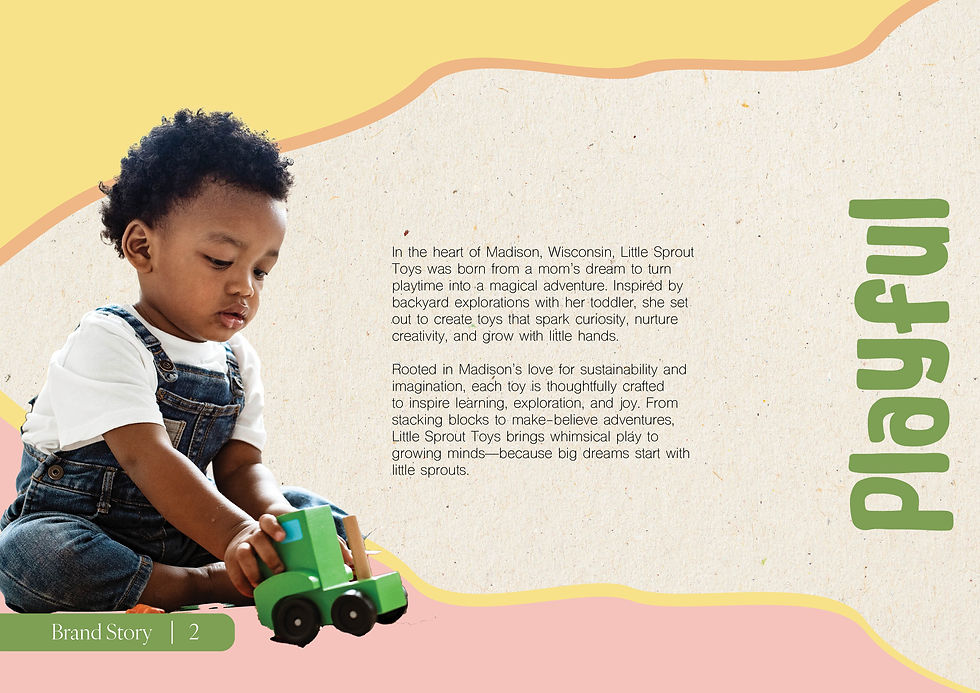
This provided valuable insight into the impact of repeating brand elements on a design's overall cohesiveness. The brand can convey a stronger identity and message to its audience by maintaining consistency in these elements. This feedback was taken seriously and applied to the brand playbook to enhance its effectiveness. The colorful hand-drawn character throughout the playbook adds visual interest and significantly contribute to establishing and reinforcing the brand identity. This thoughtful integration of design elements helps create a more engaging and memorable experience for the audience. This was where the wavy lines and hand-drawn characters came into play, anywhere they could be added to help communicate the brand message they were.


Feedback 7:
“You really need to enhance the contrast between the text and the background; it's quite hard to read.”


The first vision board had a wood background with brand imagery seemingly thrown in. The hand-drawn character elements are present and help further illustrate the brand identity. The contrast between the typography and the wood grain made the design challenging to read. To help increase the contrast between the background and typography, the wood grain was swapped out for a paper-like texture, and the typography color was changed to black. These simple changes increased the contrast and overall readability of the design.
Feedback 8:
“Your onlyness statement should be converted into something more evolved into something that demonstrates the brand to the client, not an ad copy. Not ad speak.”
Before
Little Sprouts Toys stands out as the exclusive provider of whimsical educational wooden toys designed to promote cognitive development and foster imaginative skills in young children. Our thoughtfully crafted toys are not only visually appealing but also offer engaging and interactive experiences that encourage problem-solving, creativity, and critical thinking. Each toy is made from high-quality, sustainable materials, ensuring safety and durability, while also nurturing a child’s natural curiosity and love for learning through play. With Little Sprouts Toys, parents can confidently support their child’s growth and development in a fun and meaningful way.
After
Little Sprouts Toys is a charming, nature-inspired brand that produces high-quality, sustainable wooden toys aimed at fostering children’s creativity, curiosity, and cognitive development. Committed to making learning through play engaging and meaningful, Little Sprouts Toys provides carefully crafted products that encourage imaginative exploration and critical thinking. The brand’s whimsical, eco-friendly aesthetic shines through its visual identity, featuring delightful floral and mushroom characters alongside clean, scalable designs, ensuring a cohesive and memorable experience across print, digital, and merchandise platforms. With Little Sprouts Toys, parents sow the seeds of discovery, nurturing joyful growth and lifelong learning.
Once the realization that the onlyness statement needed to be adjusted to show what the designer understood about the brand. The language typically used in advertising copy was highlighted and taken out. The entire statement was rewritten to demonstrate better what Little Sprouts Toys was at its core.
Feedback 9:
“I’m not sure that you want to say that it’s ‘Fueled by Coffee’ because that suggests that the growing, fun, and play is fueled by coffee and not by the toys.”

Feedback on the coffee mug slogan was an eye-opener for the power that simple phrasing like fueled by may have unwanted implications. It also showcased that using the same tagline or slogan across multiple promotional items can have a powerful impact on the audience.

Feedback 10:
“In a brand role out, if you throw too much at people, they don’t remember it, and they don’t distinguish “turn playtime into learning” from the others, it creates confusion in their mind they need something they can count on.”
Before

After

The first drafts of promotional items for Little Sprouts toys featured multiple different taglines, which did not provide the audience with a consistent message. Phrases like ‘Turn playtime into learning,’ ‘Growing bright minds,’ and ‘Fueled by coffee’ are theoretically appealing. Still, in practice, they fail to give the audience an explicit brand identifier, leaving them unsure who or what this product represents. This was valuable feedback because once a single tagline was selected, that tagline became connected to the brand, and the audience better understood what Little Sprouts Toys represents.
Feedback 11:
“The clean look is excellent for the playbook; I can see it relating to your vision board; you could condense your social media package to where at least two are on one page to reduce the number of pages. Also, for the logos, make sure to include what doesn’t work for the logo. Outside of that, I believe you are making good progress.”


This feedback proved beneficial during the playbook development as it emphasized that not every section required its own page. By summarizing the content into mockups, the playbook was transformed from over 23 pages to 17. Removing superfluous pages and details enhances the reader's focus, leading to improved retention and comprehension of the brand.


Feedback 12:
“The only issues would be page 4 spelled “Communications” wrong, and on pages 13-14, the use of white space feels unbalanced. Page 13 feels empty and blocky, and page 14 feels crowded.”
This feedback is a valuable reminder not to become too comfortable in a groove where mistakes can occur, as simple misspellings may happen. Always double-check writing and ensure the visual hierarchy flows throughout the design. More thought should have been put into pages 13-14 regarding the overall hierarchy and flow, which is evident in the layout of the initial playbook. Revisions were made to correct this by adjusting the hierarchy, removing images, and rearranging the page layout for better visual flow and brand messaging.
References
Aftab, M. (2025, February 12). The benefits of Collaborative design in 2024 | Best Guide - Hapy Design. Hapy Design. https://hapy.design/journal/collaborative-design/
How anthropomorphic form shapes product design. (2024, June 13). Delve. https://www.delve.com/insights/how-anthropomorphic-form-shapes-product-design
Jones, S. (2024, March 19). 12 Personal brand examples for 2024 - Personal Branding blog. Personal Branding Blog. https://personalbrandingblog.com/personal-brand-examples/
Kramer, L. (2021, August 25). The fundamentals of color psychology. 99designs. https://99designs.com/blog/tips/color-psychology/
Zock, J. (2024, July 17). Purposeful Pareidolia & Anthropomorphism in Design | Bootcamp. Medium. https://medium.com/design-bootcamp/purposeful-pareidolia-and-anthropomorphism-in-design-ce06f6d179f4